15 August, 2021

Old Way - New Way

Recently I was reminded of this strategy for helping students move on from unhelpful ways of behaving.

Often, telling someone "Do not behave this way in future" is not all that helpful, even if it is a good idea. Behaviour is often a well established pattern and more productive ways of responding may not be obvious.

Change is often about replacing old ways of doing things with new ways. But human beings are not devices - we don't have switches. So our old ways and new ways will have to co-exist for a while.

Many students need support to identify possible and new better ways of responding to difficult situations. And they may need encouragement to try new ways.

After choosing a possible new way, it can be very helpful to check with such a student from time to time:
- "How are things?
- "Had a chance to use your New Way?
- "How did it go?
- "So what next?...

The strategy promotes options for students to choose when they respond. It also helps develop insight and courage* in the student and changes the role of tutor or teacher from controller to coach and supporter.
[* Most problematic behaviour starts with the 'offender' experiencing fear in some form]


05 September, 2019

Teaching resilience

A reasonable expectation of teachers?
It is not unusual or unreasonable for teachers to "resist" taking on more and more.

One recent example, "It's not a school's job to teach your children resilience. Teachers are busy enough already" (more...).

About resilience
Resilience is fundamental to everyone's success and well-being now and in the future.

In particular resilience is fundamental to learning. Learning involves attempting thoughts and actions that one does not yet know how to do. All learning includes the risk of failure hence the need for resilience.

Learning, success and well-being all involve social and emotional aspects. We continually construct and reconstruct our knowledge, actions, arrangements and relationships, mostly in everyday interactions with others. This means that improving resilience involves social and emotional learning in the context of the activities and cultures of the school, its families and community.

The idea that resilience is something that can and should be taught by the student's teachers is true but the notion can be counter-productive, especially when teachers have to demonstrate that they have "taught resilience" as part of an industrial production model of education. The ridiculous demands on teachers to demonstrate that they have "taught X" is the major cause of "teacher resistance", narrowing of the curriculum and plateauing of student outcomes.

Teaching resilience
In fact all successful teachers, families, schools and communities naturally "teach" resilience as a matter of course. Teaching and learning resilience are best integrated into the whole life and work of the school, its families and community. It includes planning, modelling, coaching, support and celebration. Think of how toddlers learn and extrapolate that to make it developmentally appropriate for the learner.

Real-time integration of the teaching of resilience into the life and work of the school maximises the effectiveness of the "teaching' while minimising the extra demands on teachers. They are indeed "busy enough already".

A foundation of social and emotional learning
My final school had Program Achieve as its core education program. And there are numerous other social and emotional programs that provide a useful and comprehensive pedagogical framework for schools (and their teachers to adopt and live). Ideally the concepts and practices can also be shared with families and the community.

What to do...
An example from my last school involved assisting a small number of students who, when faced with a new learning task, would almost immediately recognise that they did not know what to do. They would then give up and/or seek help from the teacher.

By working with these students to better understand their needs we devised a strategy for


05 July, 2017

Understanding Social Emotional Learning

SOCIAL-EMOTIONAL LEARNING (SEL) 

I have been mulling over how to understand the social-emotional learning component of School-wide Positive Behaviour Support. The following is a summary of my current thinking

For me, at this time, I see SEL as
  • a major component of a school's taught, shared and lived curriculum. 
  • complementing the academic curriculum
  • enabling teaching, learning and belonging by and for all.

THE SEL CURRICULUM

From listening to schools in the LSN-PBS Network, and monitoring a lot of what is on the net, it seems to me that there are probably four SEL teachable dimensions:  

  • Thinking & expectations
  • Social skills
  • Habits of Mind
  • Emotional literacy
As such, these four dimensions represent an SEL curriculum that develops a way of thinking and acting that is in the best interests of all concerned. that is a curriculum that is likely to support success and well-being for all.

1. Thinking, expectations/rules/agreements - These key school aspects are described and articulated in various ways. They are intended to guide everyone's ongoing actions and interactions but and detailed meanings change from context-to-context, from setting-to-setting. To understand, appreciate, accept and support the school's requirements involves substantial social-emotional learning. The expectations have to be met, the rules observed and/or the agreements kept. The capacity to do so involves social skills, habits of mind and emotional literacy.

2.  Social skills - The ability to use verbal and non-verbal communication skills that enable successful interactions between members of the (school) community. That is to meet one's own needs in acceptable ways and to support the needs of others. For example, Teachers frequently use 

  • Attentive listening (from Tribes....)
  • Active Supervision (SWPBS...)
  • Restorative Inquiry (Restorative Practices...)
  • Affective Statements (Tribes, RP...)
  • Showing appreciation (Tribes, RP...)
  • ...
3.  Habits of Mind - Patterns of thinking and acting in one's own best interests and leading to ongoing success. For example, You Can Do It!!proposes several 'habits of mind, including...
  • Accepting myself
  • Taking Risks
  • Being Independent
  • I Can Do It
  • Giving Effort
  • Working Tough
  • Setting Goals
  • Planning My Time
  • Being Tolerant of Others
  • Thinking First
  • Playing by the Rules, and
  • Social Responsibility ... see http://www.youcandoit.com.au/AboutYouCanDoIt/
  • ...
For a more scholarly list, see also http://en.wikipedia.org/wiki/Habits_of_mind

4.  Emotional Literacy

  • Identifying, relating and communicating one's (emotional) responses to experience, and
  • Understanding and appreciating those of others.


Implications arising
It seems to me that there are some major implications from the above:

Firstly, emotional literacy underpins success including the successful use of social skills and the development of useful habits of mind.

Secondly, the key elements of most structured SEL programs include elements from each of the above SEL dimensions. Consider Tribes as a simple example. The Tribes elements are
  • Attentive Listening = habit of mind + social skill + emotional literacy
  • Showing appreciation / No put-downs = social skill + emotional literacy
  • Right to pass = emotional literacy + social skill
  • Mutual respect = emotional literacy + social skill
  • [Focus on task = habit of mind + emotional literacy]

Thirdly, social skills, habits of mind and emotional literacy are not subject to the law of physics: they are not universals in a determined sense. They are emergent, cultural and situated. This may mean that your school can simply choose its own preferred approach, and if done well, the school will make a profound contribution to the life and work of those involved, both now and in the future.

Fourthly, and keeping this last point in mind, consider your school's key expectations, e.g., "Be Safe, Be Fair and Be a Learner"


Discussion Starters
  • What are the required social skills that will enable all staff and students to meet these expectations?
  • What are the associated habits of mind that will make meeting the school's expectations natural and easy for staff and students
  • What emotional literacy is required of staff and students in order for them to understand, appreciate and achieve the school's expectations?
  • What educational strategies does your school currently have in place to develop the social skills, habits of mind and emotional literacy required?
  • What needs are not currently being addressed? That is, what are the gaps in the school's continuum of support in these areas, and how do you know (data)?
  • Possible next steps for our school?

    10 October, 2013

    Demonstrating a Restorative Circle

    Recently I had a request for a video (~10 minutes) of students participating in a restorative circle. Brief snippets are readily available within other videos but I am not aware of any that exist, except in snippets (e.g., in the West Philadelphia video on SaferSanerSchools). If you can help, please let me know. My response to the request was as follows.
    Making such a video would have some major complications. It would not be easy...
    • There is the issue of confidentiality in real circles for serious incidents. 
    •  And there are the challenges of acting and filming simulated circles given the age of the participants and the physical layout of circles (ideal for participants but difficult to record on video)
    DEMONSTRATION CIRCLES
    However, it is common practice to use role plays to demonstrate Restorative circles in workshops. This needs some setting up before hand so that the "players" have some idea of their context:
    • what happened,
    • what their character might think
    • who else might have been affected
    • and what might be done to repair the harm
    Interestingly, this "setting up" is very important and needs to happen in real-life situations. To keep everyone safe and minimise further harm it is important to get the participants' agreement to participate before taking things to the next level. There are three main levels above making affective statements
    1. Restorative Questions individually to victim* and offender* - may be sufficient for essential learning and to reduce the likelihood of minor incidents recurring
    2. Restorative Meeting jointly with victim and offender - may be sufficient to resolve a less serious issue or incident
    3. Restorative Conference (a larger circle to resolve a major issue or incident): victim, offender, other stakeholders (others effected and supporters)
    Participants need to know what their experience is likely to be if they engage in the next level:
    • what the rules will be;
    • who will be involved;
    • what questions will be asked;
    • and that they will be safe, respected and supported
    IMPORTANT PRINCIPLES
    1. Facilitators need to have a good idea of how things will go at the next level before initiating it. A facilitator should not take a matter to a higher level unless he/she is reasonably confident about the step being successful for all concerned.  Unfortunately it is possible for more problematic content to be revealed at the next level. Facilitators need to be able to handle such situations and sometimes a meeting or conference has to be cancelled or postponed.
    2*. In many situations the key players are both "victims" and "offenders" - people don't usually do the "wrong thing" for no reason!! Thus it is important not to assign victim and offender roles too strongly. Restorative practices may be well structured but they are also open.

    06 October, 2013

    Introducing Restorative Practices to a group

    Recently I received a request for suggestions regarding possible arrangements for a proposed workshop on Restorative Practices. The workshop would introduce restorative practices to a group of representative students from several schools. In response I made the following recommendations:

    IDEAS FOR THE WORKSHOP

    Use a circle and work through the restorative questions to set the scene - something along the lines of:
    - What sort of things happen at your school?
    - What do you think when these things happen?
    - Who is affected when they happen?
    - What is needed to repair the harm done?
    - Who might be able/prepared to see this happen ?

    Also get lots of the restorative question cards to give out to everyone. They are available from IIRP 

    Perhaps the best resource for comprehensive implementation of Restorative Practices in schools is at SaferSanerSchools. And the key reference for school staff is Whole School Change - Overview

    There are lots of other great school resources available from the web
     - Villanova College is a great example of a good highly successful school using Restorative Practices really well
     - West Philadephia is a great example of a highly challenged school using Restorative Practices really well. Information available from SaferSanerSchools 

    If you are working with staff, they need to understand the Social Discipline Window - it will help them make better sense of what is happening. 
    [Note: I often change the term 'Control' to 'Challenge' to make the model more relational, and more consistent with the idea of 'working WITH' rather than 'working ON' students. The idea of  'controlling' is also fundamentally misleading and unrealistic except perhaps in the short-term]

    RESTORATIVE PRACTICES IN SCHOOLS

    In schools, Restorative Practices are not just about fixing problems that have occurred. As elsewhere, Restorative Practices are about building community within, and beyond, the school. Restorative Practices are also educational and provide an powerful basis for social and emotional learning by all members of the school community - staff, students, their families and other stakeholders.

    08 January, 2013

    Emotions - hardwired or taught?

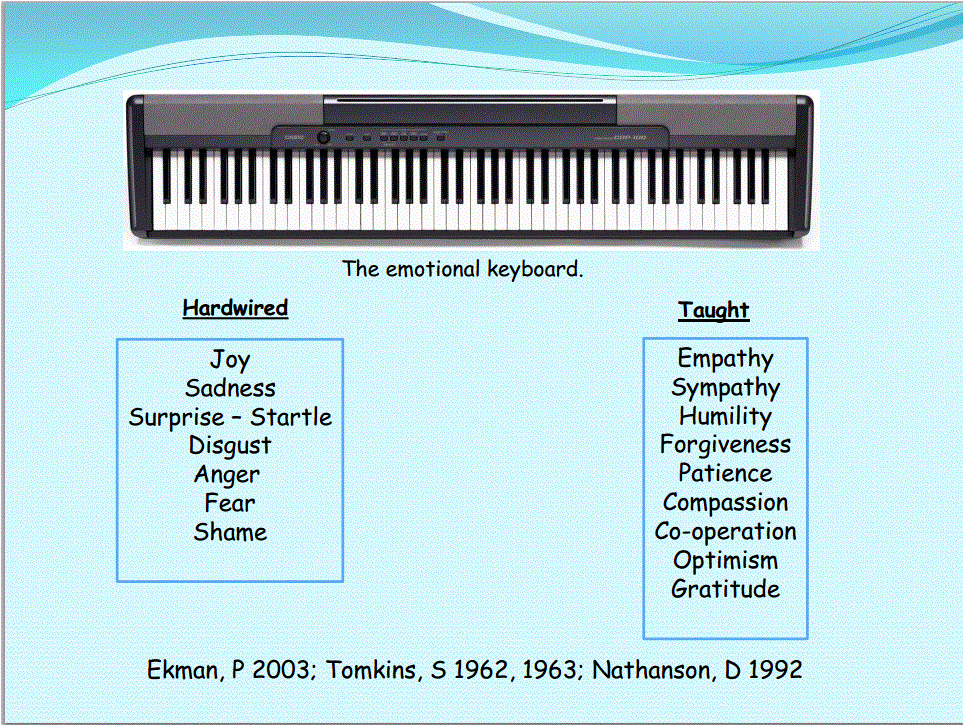
    Nicola Preston's presentation to the IIRP UK & Ireland 2012 Conference includes the following slide:


    This slide could be a great starting point for reviewing current arrangements for Social and Emotional Learning in any school.

    In particular it raises the questions of 
    • what (emotions) will be taught, and 
    • what pedagogies will be used.
    Obviously conventional notions of curriculum as delivered content are unlikely to be all that successful. Rather it is necessary to situate much of the learning within the everyday lived (emotional) experience of the students and other members of the school community.  Fortunately there is a rich set of everyday possibilities available - see Pedagogies for SEL

    21 September, 2012

    Restorative Schools - some major trends

    My online newspaper, Restorative Schools, is out today and every Friday.

    As well as useful resources there are several reports of big reductions in suspensions in a number of US schools and school systems using Restorative Practices. The reports are based on data from previous school  years. The numbers of students suspended and/or excluded has been mind-boggling (at least to me) and the reductions achieved have been very impressive.

    Other trends include
    • increasing pressure to reduce suspensions and exclusions
    • the introduction of laws in some parts of the world to mandate the use of restorative and similar practices in schools
    • endorsement of Restorative Practices by a wide range of authorities
    • initiatives by cities around the world to become Restorative Cities
    • schools playing a leading role in the spread of restorative practices within communities
    All the best,
    Ivan

    26 July, 2012

    Demonstrating order

    When harm is done it is relatively easy to identify the primary relationships that have been damaged and need to be restored. In serious matters, restorative practices address close secondary relationships by including supporters of both the offenders and victims.

    Well-meaning authorities may attempt to "keep the door open" for those who have caused some harm by implementing minimal consequences. For example, a court may apply a suspended sentence for a serious offense. In terms of the social discipline window, such approaches can be perceived as high support - low challenge. However, this can undermine the confidence of bystanders and their relationships with those involved and the system (justice system, school...). A bystander is anyone who knows that harm was done, before, during or after the fact. 

    High challenge - high support approaches include the completion of substantial well-managed challenges by those who have caused harm. As part of the restoration of relationships, such challenges are likely to be known to those directly involved in any restorative processes. Communicating the successful completion of real challenges can be important for wider bystanders who need to know that justice has been done, and that there is order including social discipline.

    18 July, 2012

    Push-outs and zero tolerance in Australia

    Push-outs and Zero Tolerance fail to deliver in the US
    In the US zero tolerance is being abandoned as a core strategy to improve school safety and student achievement (IIRP). This shift is closely associated with widespread concern about the long term implications of push-outs.
    • Zero tolerance is usually implemented by suspensions and expulsions for unacceptable behaviour and can easily result in permanent push-outs
    • Push-outs disrupt a students' education and place them in situations where they are more likely to do dangerous and unacceptable things. This frequently moves students to the periphery of society permanently. For many the effect is a "school-to-prison" pipeline
    Is Australia different?
    Zero tolerance has not be explicitly adopted in Australian schools and we don't use or have a term that is equivalent to push-out. But does this mean that the phenomena do not to be found in Australia? Certainly not. 
    Both zero tolerance and push-outs are alive and well down-under, but politely masked by a number of factors including failure of the student to meet the "required standards" of behaviour and/or academic progress. Families, communities and even school systems (unconsciously) collude with schools to maintain the masking of intolerance and exclusion.

    Understanding push-outs
    Particular students are excluded (pushed out) from particular schools for a wide range of reasons
    • Despite receiving government funding, non-government schools select their students from those who apply and in the process usually exclude the the least promising. That is, many students are pushed "out" from non-government schools before they are "in"!!  In contrast many of the same non-government schools offer scholarships to the most promising students in order to ensure that they get "in".
    • Should difficulties arise after being enrolled, students at non-government schools can be pushed out by having their enrolment terminated without much difficulty
    • Government schools may suspend students for short periods for less serious behavioural issues or exclude students permanently for serious matters. The school system then attempts to find an alternative school placement for the excluded student.
    • Students with high levels of special needs are less likely to be enrolled in non-government schools and may not be "main-streamed" in government schools if the schools cannot make provision that meets their needs.
    • Some students exclude themselves by refusing to attend school often as a result of social, emotional or material issues that make it difficult to meet the school's requirements
    • The latter students may also behave in unacceptable ways that result in their being excluded by the school
    • Or they may be pushed-out by their fellow students through bullying and harassment
    • Also families sometimes fail to enrol their children in school, fail to support attendance or even discourage attendance by their children for personal reasons
    • And families (and their children) can be pushed out from communities
    In Australia, non-government schools are widely believed to provide better quality education. And this belief is supported by school performance data available from the MySchool website. A high proportion of non-government schools may well be safer and have better student outcomes (learning, attendance, parent satisfaction...) precisely because of their zero tolerance and the use of push-outs to other schools, particularly to government schools.
    To a lesser extent some government schools have similar practices. The net result is that there is a movement of the most needy students away from the provision and social capital that could best meet their needs.

    At the same time, some of the most courageous and genuinely high performing schools are to be found at the periphery although this is far from obvious from the available school performance data.


    Schools that use zero tolerance have no real need to develop more inclusive strategies such as school-wide positive behaviour support and restorative practices.

    07 July, 2012

    Meeting School Requirements

    There are limits to the range of sustainable provision that schools can make for their students. These limits are defined by the organisation, scheduling, arrangements and practices within the school.
    And schools have requirements of their students. To a greater or lesser extent, most schools require students to be
    • at school - all day, everyday (in uniform?)
    • responsive within narrow timelines
    • in class and on time, every time 
    • ready for work - physically, emotionally, financially (with fees, materials & equipment), tasks completed, necessary prior knowledge & skills 
    • on task
    • compliant with school rules - no harm, no disruption & no offense to others 
    • able to acquire necessary out-of-school resources
    • able to complete out-of-school tasks (homework, work experience....)
    These requirements are very reasonable for the vast majority of students. However it is virtually impossible for some high needs students to meet these requirements because of the combined effect of
    • poverty
    • ineffective parenting (especially lack of social and emotional learning)
    • fight/flight responses
    • family arrangements
    • health issues (ASD, ADHD, PTSD, various disabilities...)
    • cultural differences
    • fragmented attendance
    • ... 
    For many students (80%?) school's requirements are rarely an issue. But, for high needs students the requirements can be an on-going moment-by-moment challenge, especially when things go wrong!!

    Restorative Practices can be helpful in acknowledging and addressing these factors and thus help more students meet the school's requirements resulting in better outcomes for all.

    03 July, 2012

    Restorative Practices - Breaking down the silos

    Sometimes silos can  be useful when they concentrate effort for specialist purposes. On the other hand silos can become barriers to collaboration between people who are struggling to meet the challenge of complex problems.

    One of the strong themes associated with Restorative Practices is the breaking down of barriers between stakeholders.

    As these barriers dissolve new, stronger, more positive relationships, practices and arrangements often emerge leading to greater success and well-being for all concerned.

    It is often individual staff members in schools and services groups, government agencies... who lead the way in breaking down the silos that exist between their respective organisations. 

    They do this by collaborating to improve their support for those who need it most. With luck, senior management will notice the improvements being achieved and incorporate the new practices of their respective organisations.

    In this way the silos of education, welfare, health and justice are being broken down so that young people in need are receiving more effective support.

    16 June, 2012

    Restorative Pratices - where is your focus?

    This week, as usual, I saw lots of headlines about schools reducing suspensions, having fewer problems... These messages seem to be mainly messages to the community about the school . Fair enough!! But one slightly different headline caught my eye - it was a message to students:
    •    "We want you here!" (more)
    Such schools are voicing a direct commitment to their students, all their students!! Not just those who arrive at school in reasonable shape and comply with the schools' expectations.

    Many problematic students are not wanted anywhere else in our communities... school might be their only chance to be wanted in a healthy community, yet to belong is a basic human need we all share. This is fundamental to the success of Restorative Practices - that those who have done harm can still belong.

    How clearly does your school communicate with the students that they are wanted?" 

    21 May, 2012

    Doubts about Restorative Practices

    I am noticing more expressions of doubt about the efficacy of Restorative Practices (RPs).  
    The implications are that we may need to communicate better with our 'constituents':

    1. RPs are not a panacea - it is not always the only answer to the immediate problem
    2. We don't use RPs as an either/or strategy - it is an important (but not the only) part of what we do to repair relationships and the harm done when things go wrong between people.
    3. RPs are not just a form of high support - done properly they exert a high level of control and are also challenging to all concerned (ref. The Social Discipline Window)
    4. RPs are not done TO or FOR 'offenders'.
    5. Restorative Practices need to be done professionally - critics often see RPs as an amateurish activity, and perhaps that is what they have seen.

    15 October, 2011

    3 Tiers of Restorative practices

    I came across this diagram explaining three levels of intervention as it applies to the use of Restorative Practices.


    For those involved in School-Wide Positive Behaviour Support or PBIS, this diagram will be very familiar!!

    It is really the same idea as the triangle of universal, secondary and tertiary SWPBS interventions.

    In simple terms, the three ties of intervention using restorative practices are as follows:
    • School-Wide Prevention Practices include the
      • use of affective statements
      • extensive use of circles for a wide range of everyday purposes
      • and all the SWPBS universal interventions
    • Managing Difficulties includes
      • the use of the restorative questions
      • more use of circles focused on existing and/or emerging issues with selected students
      • restorative meetings
    • Intense Intervention includes
      • restorative conferences
    The diagram is from Restorative Justice - a working guide for our schools - a sound, easy-to-read guide to implementing what some call "restorative practices" at the school or school district level.

    30 September, 2011

    What is it that Restorative Practices actually restore?

    Recently I have been pondering the question:
    • What is it that restorative practices actually restore?
    Obviously there are lots of possible answers to this question. For example, a school that was using Martin Seligman's approach to Well-Being would use restorative practices to restore the 5 main elements (PERMA) that contribute to success and well-being, namely,
    1. Positive Emotions – experiencing joy and pleasure
      • While the outcomes of bad experiences are the opposites of joy or pleasure, it is important for people to ultimately feel more positive after dealing with the bad things that they have done, or have been done to them. 
      • Unfortunately, some traditional approaches leave people who have caused harm to others in the state of feeling bad (shamed) about what they have done as 'logical consequence'. However this is likely to result in on-going disengagement, resentment and other limiting factors.
      • Similarly, traditional approaches often fail to address the emotional needs of the person who has been harmed so that they continue to feel bad about what has been done to them
    2. Engagement (or flow) – being consciously involved in our activities
      • Managed disengagement (isolation, suspension...) is also often seen as a 'logical consequence' of doing the wrong thing but this reduces the likelihood of productive  engagement
    3. Relationships – having enjoyable and supportive interactions with others
      • Damaged relationships are very often a result of wrong doing. Failing to restore damaged relationships is likely to result in a long term state of reduced success and wellbeing
    4. Meaning – creating a purposeful narrative about our lives; being engaged with or serving something larger than ourselves
      • Having been harmed, or having caused harm to others, changes our personal narratives for the worse. Experiencing restoration of positive emotions, engagement, relationships... helps to restore constructive meaning in our lives.
    5. Accomplishments – completing our goals and following our core values.
      • Those who have been harmed, or caused harm, are likely to experience a sense of failure. If unresolved this is likely to reduce a person's subsequent capacity to achieve and act in ways that better match their own core values.
    Clearly restorative practices provide rich ways of restoring each of the five elements of Well-Being.

    What is your school's answer to this important question?

    31 July, 2011

    Well-being Theory - Positive Education

    Authentic Happiness - revised

    Martin Seligman has revised his Authentic Happiness theory (2002) on the basis that it over-emphasised feeling good.

    In his latest book Flourish he has outlined his Well-Being Theory as follows

    Well-being is a construct, and well-being (not happiness) is the topic of positive psychology.

    There are five measurable elements (PERMA) that contribute towards well-being:
    • Positive Emotions – experiencing joy and pleasure
    • Engagement (or flow) – being consciously involved in our activities
    • Relationships – having enjoyable and supportive interactions with others
    • Meaning – creating a purposeful narrative about our lives; being engaged with or serving something larger than ourselves
    • Accomplishments – completing our goals and following our core values.
    Follow this link for more on Positive Education.


    Exercises:

    1. Consider three students with whom you work: one high status/high achiever; one average; one who is in difficulties. Rate each student on a scale of 1-10 for each of the measurable elements.  What common beliefs does this reveal, confirm, challenge?
    2. Retiring? Returning to work or study? Changing employment? How are each of the PERMA elements likely to change? And what might you need to attend to?

    And Martin Seligman introduces Positive Psychology in a TED Talk

    25 July, 2011

    Explicit teaching & positive reinforcement of expectations


    One school's example

    The expectations of Tasmania's Evandale Primary School are based on PURRing! Students are explicitly taught to P.U.R.R.
    • Perseverance
      • By always trying our best and taking pride in our achievement.  
      • Learn all we can by listening, participating and completing work on time
    • Understanding
      • For each other, being courteous, cooperative and friendly
    • Respect
      • Our school - by keeping classrooms and grounds clean, tidy and free of litter, vandalism, graffiti.  
      • Respect other people - their feelings, personal space and property
    • Responsibility
      • Care for our equipment.  
      • Follow established classroom rules and routines.  
      •  Work, move and play safely
    Students receive recognition of positive behaviour with PURR points:
    • 20 = icy pole; 
    • 40 = classroom book; 
    • 60 = small prize; 
    • 80 = passport to help out in another class; 
    • 100 = recognition morning tea.
    This positive reinforcement scheme is a nice example of using "free and frequent" reinforcement to build a continuum of recognition.
    Thanks to Deb Rigby at Evandale for sharing her school's great practice!

    24 March, 2011

    #2 - Emotional Literacy

    This is the second of eight discussion starters covering aspects of Social and Emotional Learning (SEL).

    Emotional Literacy
    Given that we are social and emotional beings it is somewhat paradoxical that Emotional Literacy is perhaps one of the least considered aspects of SEL.

    Schools teach values, social skills, habits of mind and thinking skills in order to improve behaviour and learning. But all these are informed and shaped by the emotional literacy of those involved (staff, students, their families, their communities....)

    Emotional Literacy and our most challenging students
    Think of some of the most challenging students in your school
    Q1.  How well do they understand the emotional experience of those around them?
    Q2.  How well do they understand, manage and respond to their own emotions?

    And what about low achievers who are depressed and/or give up too soon?

    For more about emotional literacy go Emotional Literacy

    #1 - Introducing SEL

     
    In a recent role, I became acutely aware of how confusing the area of social and emotional learning (SEL) can be !! Is it social skills, or values, or a specific program ....

    There are numerous programs and recommended approaches that imply they have the answer. If only it was that simple !!

    Mapping SEL in your school

    In response, I have tried to map and relate the various approaches being used in a range of schools. The result is an (interim) framework that may be useful, even if it is not simple!!

    Over the next several weeks I will share my thinking in ways that might be useful for inschool professional learning, e.g., discussion groups.

    Week 1 - Five basic Ideas underpinning the possible SEL Framework

    1. We are all social and emotional beings
    2. We promote social and emotional learning in all our interactions
    3. There is a wide range of pedagogies available for teaching SEL
    4. The outcomes of social and emotional learning are improved with

    • Emotional literacy
    • Social skills
    • Habits of mind
    • Thinking (and expectations)
    5. These four dimensions of SEL overlap, support and complement each other

    For more on this topic, see  Introducing SEL - this page may be useful as handout or discussion starter

    Let me know what you think.

    23 February, 2011

    Restorative Practice and Peer Mediation


    Numerous approaches to Peer Mediation
    Obviously, there are numerous approaches to support student problem solving and associated peer mediation skills. Most rely on the school identifying, training and equipping, and deploying suitable students.
    And there are numerous schools around the world that have been able to extend the use of Restorative Practices to include peer mediation. In building  their school as a community, they have worked to involve everyone in Restorative Practices: staff, students, their families and the wider community.

    These schools have explicitly trained students in the use of small circles and  the restorative questions as part of establishing a restorative culture across the school and its community. They have then created some level of peer mediation by training and encouraging the students to use small circles and the RP questions in real everyday situations to make better responses to the situations that arise.

    Peer mediation is not new 
    But promoting Peer Mediation is not a new, separate, isolated endeavour. In almost all circles that work well , many students already do a great deal of 'peer mediation'  - probably more than they realise. So just pointing this out (making it explicit) can be useful. If we know about the good things we can do, then this generally increases our capacity and willingness to do more of them.

    Peer mediation by everyone? 
    Training does not need to begin with selected students. "Helping to resolve peer issues" might be a great topic for a class circle. The social and emotional learning that will result is likely to enable many students to take positive action when things go wrong.

    For example, bullying rarely occurs without an extensive range of bystanders. To reduce bullying it makes sense to enable, support and encourage 
    • bullies to better understand the implications of their actions
    • bullies to repair the harm done, and
    • all bystanders to make more constructive responses. 

    Clearly this is the very kind of activity for which Restorative Practices has been developed.
    It would be interesting to see what might emerge if, say playground/classroom mediators were elected by their peers. Worth a try?

    Restorative Practices as a springboard from Peer Mediation
    So if your school is developing a restorative culture there numerous possibilities just from Restorative Practices alone. And, of course, then there are other sources of ideas, processes and practices relating to Peer Mediation.